Hard Shell, Soft Centre: Vandal Resistance Beyond the IK Label on UK High Streets
Photo: vandal resistant dome CCTV camera UK high street pole, via www.delcompany.com
A camera datasheet can say IK10 in large type and still leave a UK buyer exposed. On a high street, at a bus interchange or on a housing estate, the threat is rarely one clean, laboratory-style strike. It is a bottle, a skateboard, a scaffold pole, a repeated kick, a levered bracket, a pressure washer and a decade of weather. IK10 is a useful starting point, but it is not a warranty against vandalism and it is not a substitute for reading the whole enclosure design.
What IK10 actually certifies
The IK scale is defined in BS EN 62262 and its international equivalent. It expresses the degree of protection an enclosure provides against external mechanical impacts. IK10 corresponds to an impact energy of 20 joules. That is a meaningful hit, roughly in the region of a 5 kg weight dropped from about 0.4 m, but it is delivered in a controlled way. The test uses a defined striker, a defined energy and a defined set of impact points on a sample enclosure. It is not a test of how a camera behaves when someone attacks it with a hammer, levers the housing with a screwdriver or repeatedly strikes the same weak point.
That distinction matters commercially. An IK10 declaration normally applies to the main enclosure. It may not apply to the dome window, the cable gland, the mounting bracket, the sunshield or the joint between the housing and the wall box. A product can therefore carry an IK10 rating and still fail in service because the first thing an attacker reaches, or the first thing that degrades, is outside the scope of that one number.
Where public-realm cameras fail first
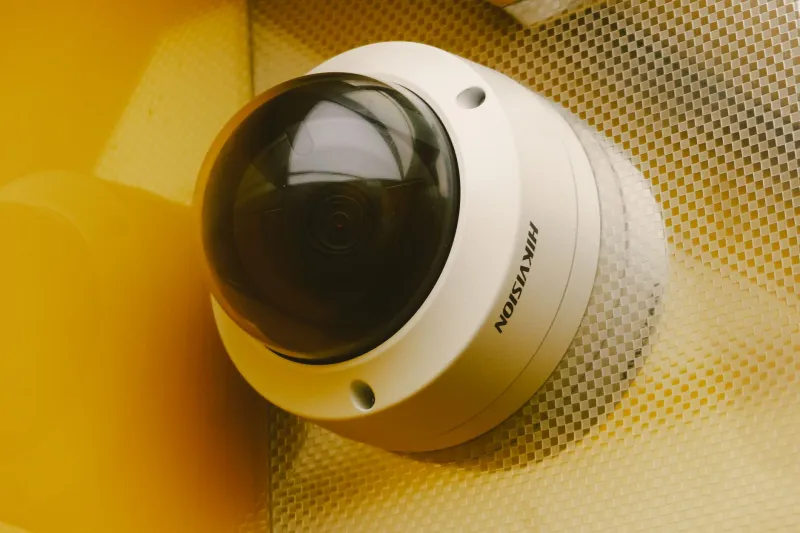
Dome cameras are common on UK high streets because they are discreet and difficult to point away from the scene. They are also the most obvious place to look for a gap between the label and the real world. The dome window is usually a polymer or glass component selected for optical clarity, not for repeated impact. Polycarbonate is tough, but it scratches; acrylic can craze; glass resists scratching but can shatter. A dome can remain structurally intact while its optical surface becomes progressively useless through abrasive cleaning, graffiti removal, UV exposure and small impacts. If the window is not replaceable, a cosmetic problem becomes a full camera replacement.
Housings have a different failure pattern. A cast aluminium body may survive the strike that dents a thin wall box or shears a fixing. Powder coating chips, exposing aluminium to the damp UK climate. Stainless screws of the wrong grade react with the casting. A cable gland that is not protected becomes the entry point for water. The result is not an immediate IK failure but a slow reliability problem that appears months later, often after the installer has left site.
Transport interchanges and housing estates add specific pressures. Bus stations see heavy footfall, cleaning regimes and occasional disorder. Housing estates see attempted theft, levering and opportunistic damage. Town-centre schemes see event-day crowding and temporary infrastructure that can be used as a platform. In each case, the camera is part of a physical system: bracket, pole, wall box, conduit and fixings. A vandal-resistant camera on an inadequate bracket is not a vandal-resistant installation.
The seal is the weak point
IP ratings and IK ratings are often quoted together, but they are not tested together in the way buyers assume. An IP66 or IP67 rating demonstrates sealing on a new sample under defined conditions. It does not promise that the same seal will survive a heavy impact, a distorted housing or a cracked window. Once the enclosure is deformed, the gasket path changes. Water finds the gap, and the fault appears as condensation, image haze or a failed board rather than as visible vandal damage.
Specifiers should therefore ask how the seal is protected, not just what IP number appears on the datasheet. Look for gasket channels that are shielded from direct impact, cable entries that are recessed or guarded, and fixings that do not pass through the sealing zone. Stainless hardware, captive fasteners and replaceable glands are practical details, but they are the details that decide whether an estate survives its first winter after an incident.
Lens, coating and serviceability
Two cameras can both be IK10 and behave very differently after five years. The difference is often the optical window and the service model. A hardened glass window may resist scratching and cleaning chemicals better than a polymer dome, but it can fail more dramatically under a sharp impact. A polycarbonate dome may absorb impact and stay in one piece, but it will scratch and cloud. Neither choice is universally correct; the specification should follow the site. A sheltered town-centre column has a different risk profile from an exposed estate gable.
Serviceability is the commercial test. Can the window, dome or lens cover be replaced in situ with a security tool? Are spare parts available in the UK, and are they the same revision as the installed unit? Are the fixings captive so that they cannot be lost on a pavement? A camera that must be returned to a bench, or replaced entirely, for a scratched dome carries a hidden cost that rarely appears in the tender price.
Specifying beyond the badge
A practical UK specification should treat vandal resistance as a set of requirements rather than a single code. Ask for the IK rating by component, not only for the main body. Request the test report and confirm which laboratory produced it and which standard was applied. Check whether the dome or window is included in the tested configuration. Ask how the IP rating is maintained after impact and what design features protect the gasket path.
On site, consider height and access. A camera at 2.5 m on a high street is within reach of a determined person with a pole; a camera at 4 m is not, but it may be harder to service. The bracket, pole and wall fixings should be specified with the same care as the camera. Security Torx or proprietary fixings slow an attacker, but they also slow the maintenance team, so keep the tooling policy realistic. Standardise across the estate where possible, and hold spares for the parts most likely to be damaged.
Finally, ask for whole-life evidence. A low-cost camera with a non-replaceable dome can cost more over a five-year term than a higher-cost unit with a stocked spare window. In 2026, with public-sector budgets under pressure, that argument is easier to make with a simple table: unit cost, replacement part cost, callout cost, expected frequency and downtime. Vandal resistance is not a label on a box. It is the sum of the enclosure, the optics, the mounting and the maintenance plan.