When the Bracket Fails First: Corrosion-Engineered CCTV for UK Coastal Sites
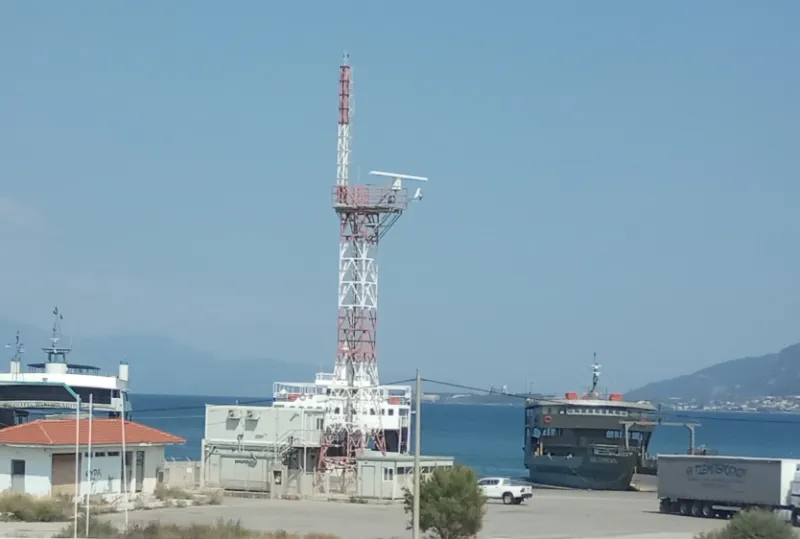
Photo: Peloponnisios, CC BY-SA 4.0, via Wikimedia Commons
Coastal CCTV failures rarely begin in the image sensor. They begin at a cut edge of powder coat, a mild-steel screw threaded into an aluminium bracket, or a gland that points upward into wind-driven rain. By the time moisture reaches the camera, the installation has already been compromised. For UK trade buyers specifying systems on exposed coastlines, the useful unit of specification is therefore not the camera alone but the whole external assembly: housing, bracket, fixings, connectors, cable entry and service access.
IP66 Is a Water Test, Not a Salt Test
The IP rating is often treated as a coastal suitability statement. It is not. IP66 and IP67 describe protection against dust and water ingress under defined test conditions; they say nothing about chloride-induced corrosion, UV degradation of polymer parts, or the galvanic behaviour of mixed metals. A camera can pass an IP66 test in a laboratory and still suffer pitting corrosion on a stainless screw, creepage corrosion under a powder-coated aluminium bracket, or contact failure inside a connector that has been repeatedly wetted by salt spray.
A more useful reference point is the corrosivity category framework in ISO 9223. UK coastal sites are not uniform: a sheltered estuary may behave closer to C3, while exposed headlands in Cornwall, Pembrokeshire, North Norfolk and the Western Isles can reach C4 or C5, with splash zones around sea walls and harbour walls effectively requiring CX-level thinking. The practical implication is that the same camera model may be acceptable 400 metres inland and inappropriate on a sea-facing gantry. Trade buyers should ask for the intended corrosivity category, the housing material and finish, and evidence of salt-spray testing to ASTM B117 or ISO 9227. Salt-spray hours are not a warranty, but they are a useful screening tool when comparing products that otherwise look similar on a datasheet.
Specify the Assembly, Not the Camera
Most coastal failures are mechanical and electrical rather than optical. Stainless-steel fixings are often specified as a default solution, but 304 stainless is not a marine grade. Where chlorides are present, 316 or 316L stainless should be the baseline for exposed screws, washers, brackets and gland bodies. Even then, direct contact between stainless fixings and an aluminium housing can create a galvanic couple, particularly when water sits in a crevice. Isolating washers, nylon bushes and compatible sealants are not accessories; they are part of the corrosion design.
Cable entry deserves equal attention. A downward-facing gland with a proper drip loop is preferable to an upward-facing entry sealed with silicone. Where connectors are exposed, hardened RJ45 assemblies, gel-filled connectors or fibre links may be more appropriate than a domestic-style patch lead. Dielectric grease can help on low-voltage contacts, but it is not a substitute for a correctly rated enclosure. PoE injectors and midspans should be located in a dry cabinet or internal riser, not strapped to a mast where condensation cycles will do the damage.
Polymer, Aluminium and Stainless: A Comparison Framework
The three common housing families suit different risk profiles. The table below is a starting point for tender comparisons, not a substitute for site-specific assessment.
| Material | Best suited to | Strengths | Risks on UK coasts | Specification prompts |
|---|---|---|---|---|
| UV-stabilised polymer | Lower-risk coastal outbuildings, temporary or retrofit positions | Non-metallic, avoids galvanic coupling, low weight, lower cost | UV embrittlement, thread wear, thermal movement, limited structural stiffness | Confirm UV stabilisation, metal thread inserts in 316 stainless, and realistic service life in direct sun |
| Powder-coated aluminium | General coastal perimeter and building facades | Good thermal path, mature mounting ecosystem, moderate cost | Coating damage at cut edges, crevice corrosion, galvanic reaction with stainless fixings | Marine-grade pretreatment, coating thickness and repair procedure, isolating washers, sealed cut edges |
| 316L stainless steel | Exposed headlands, harbour walls, splash zones and high-maintenance-cost positions | High corrosion resistance, structural strength, long service intervals | Cost, weight, crevice corrosion in stagnant chloride traps, welding discolouration | 316L rather than 304, passivated welds, drainage paths, compatible fixings and inspection regime |
Polymer housings are often dismissed as a budget option, but on a low-risk inland-facing elevation they can be sensible, especially where a metallic bracket would introduce a galvanic pair. Aluminium remains the workhorse of UK CCTV, but its performance depends heavily on pretreatment and coating quality. Stainless is not automatically maintenance-free: 316L can still suffer crevice corrosion where salt deposits remain trapped against a gasket or under a bracket. The specification should include drainage, stand-off clearance and a cleaning regime, not just the alloy grade.
Mounting Hardware and the Hidden Galvanic Cell
Brackets, masts and adaptors are frequently bought as generic items. On a coastal site, that is where money is lost. A galvanised mild-steel bracket with a stainless bolt and an aluminium camera body creates a small electrochemical cell; add wind-driven salt spray and the least noble metal corrodes first. The visible result may be a stiff pan-tilt head or a bracket that fails at the weld, long before the camera electronics show a fault.
Trade buyers should require a mounting schedule that states the material and finish for every exposed component, including anchor bolts, hose clips and cable ties. Where dissimilar metals cannot be avoided, specify isolating washers and a compatible sealant, and ensure that water cannot pond in a joint. Vibration and thermal cycling also loosen fasteners; thread-locking compounds and torque settings should appear in the handover file, not be left to the installing engineer's habit.
Maintenance Intervals That Reflect the Coast
A single annual service visit is rarely enough for an exposed coastal camera. In C4 or C5 environments, a six-month inspection is a more realistic starting point, with quarterly checks in splash zones or where the camera is directly exposed to prevailing south-westerly weather. The inspection should include a freshwater rinse of salt deposits, a check of gaskets and glands, replacement of desiccant where fitted, verification of drain holes, and a torque check on fixings. Corrosion is often visible at the fastener head before it reaches the housing; that is the point to intervene.
The handover pack should record the corrosivity assumption, the materials specified, the inspection interval and the cleaning method. It should also state what is excluded from warranty: coating damage from pressure washing, incorrect cleaning agents or unauthorised modifications are common exclusions. For UK trade buyers, that record is as important as the camera datasheet when a site is audited or a maintenance contract is renewed in 2026.
Coastal CCTV is not a product category; it is an environmental specification. The successful approach is to treat the camera, bracket, fixings, glands and cable entry as one corrosion-managed assembly, then match the materials to the exposure and the maintenance budget. The bracket that fails first is usually the one that was never specified as part of the system.