Safeguarding by Field of View: A Room-by-Room CCTV Method for UK Schools and Care Settings
Why a generic school CCTV template fails
Schools and care settings are not ordinary commercial sites. A camera in a corridor, a dining hall or a reception area may be justified; a camera that overlooks a changing area, a bathroom entrance or a bedroom is a different proposition. Generic templates often specify coverage by building type rather than by purpose. That is how excess field of view, unnecessary audio and indefinite retention enter a system that should be proportionate from the start.
The legal framework is familiar but easy to reduce to a slogan. UK GDPR and the Data Protection Act 2018 require lawful, fair and transparent processing. The Surveillance Camera Code of Practice, issued under the Protection of Freedoms Act 2012, sets out principles for surveillance camera systems in England and Wales. Schools also work within safeguarding guidance, and care settings within their own regulatory regimes. The exact duties vary by nation and setting, so the specification should reflect the actual site, not a copied policy.
Start with a room register, not a camera count
Before choosing hardware, build a room-by-room register. For each zone, record the purpose of surveillance, the lawful basis, the camera position, the field of view, any masking, whether audio is enabled, the retention period, signage, access roles and the review date. This register is more useful than a bill of materials because it forces the question: what is this camera for, and what is the least intrusive way to achieve it?
Classify each zone by sensitivity. Perimeter and external approaches are usually lower risk. Reception, corridors and communal areas are controlled circulation. Rooms where children, vulnerable adults or staff are likely to be in a state of undress, receiving personal care or having confidential conversations are sensitive or prohibited. The classification should drive the specification, not the other way round.
Field of view is the first privacy control
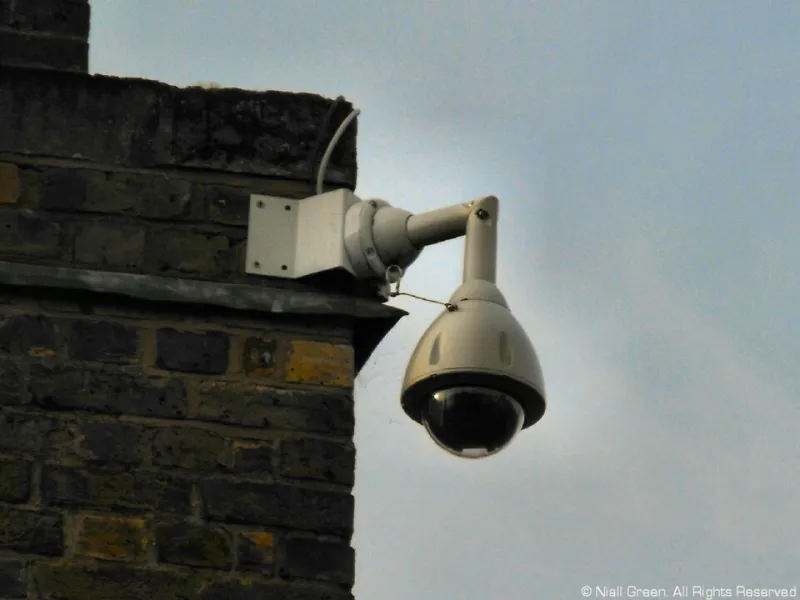
A wide lens is not a neutral choice. It decides how much of a room, doorway or neighbouring property enters the frame. Use the narrowest field of view that meets the purpose. Position cameras so that they look at access points rather than into rooms. A corridor camera angled along the corridor is usually easier to justify than one that captures the interior of every doorway.
Where a camera unavoidably overlooks a sensitive area, use privacy masking at the camera, not only in the video management software. Camera-side masks are more robust because they apply before recording. Verify the masks after every firmware update, lens change or camera replacement. A mask that silently disappears is a data protection incident waiting to be discovered.
Audio, signage and the expectation of surveillance
Two-way audio and environmental audio are high-risk features in schools and care settings. They should be disabled by default and enabled only with a clear, documented justification. Conversations in a reception area or a care corridor can contain special category data. If audio is necessary, the privacy notice and signage must say so, and access to recordings must be tightly controlled.
Signage should be placed at entrances and, where appropriate, at zone boundaries. It should identify the controller and provide a route to the privacy notice. A sign at the car park does not adequately inform someone entering a care unit. Transparency is not a single laminated sheet; it is a system of notices, policies and staff awareness.
Retention, access and the DPIA
A DPIA should be completed before procurement, not after installation. It should describe the purpose, necessity and proportionality of the system, the risks to individuals and the measures taken to mitigate them. Retention should be set by purpose and documented in the register. 'Keep it for 30 days because that is the default' is not a retention policy. Access should be role-based, logged and reviewed. Administrators should not be the same people who routinely export footage.
Subject access requests and safeguarding investigations both depend on retrievable, protectable evidence. Redaction workflows should be agreed in advance, and exports should be logged. Where a cloud or remote-monitoring service is used, the contract needs data processing terms, retention controls and clear responsibility for access management.
Care settings: dignity, capacity and consultation
In care settings, the starting point is dignity. Bathrooms, toilets, changing areas and similar spaces should not be covered. Bedrooms require exceptional justification, consultation with residents and families where appropriate, and a clear assessment of capacity and consent. Staff monitoring is not the same as safeguarding residents. A camera that watches staff breaks or private conversations may be proportionate for one purpose and disproportionate for another.
Consultation should be recorded. It is not enough to say that residents were informed. The register should show who was consulted, what alternatives were considered and why the chosen field of view is the least intrusive option that works.
What trade buyers should put in the specification
Ask suppliers for camera-side masking, configurable retention, audit logs, role-based access, audio disabled by default and a firmware support statement. Request a handover pack that includes the room register, DPIA reference, signage templates, retention schedule and an export procedure. A school or care setting does not need more cameras. It needs cameras whose fields of view can be explained, defended and reviewed.
Safeguarding by field of view means designing the system around the people in the room, not around the coverage diagram. That is the standard UK trade buyers should apply in 2026.