Paper Brightness, Street Legibility: Outdoor Display Specification for UK Sites
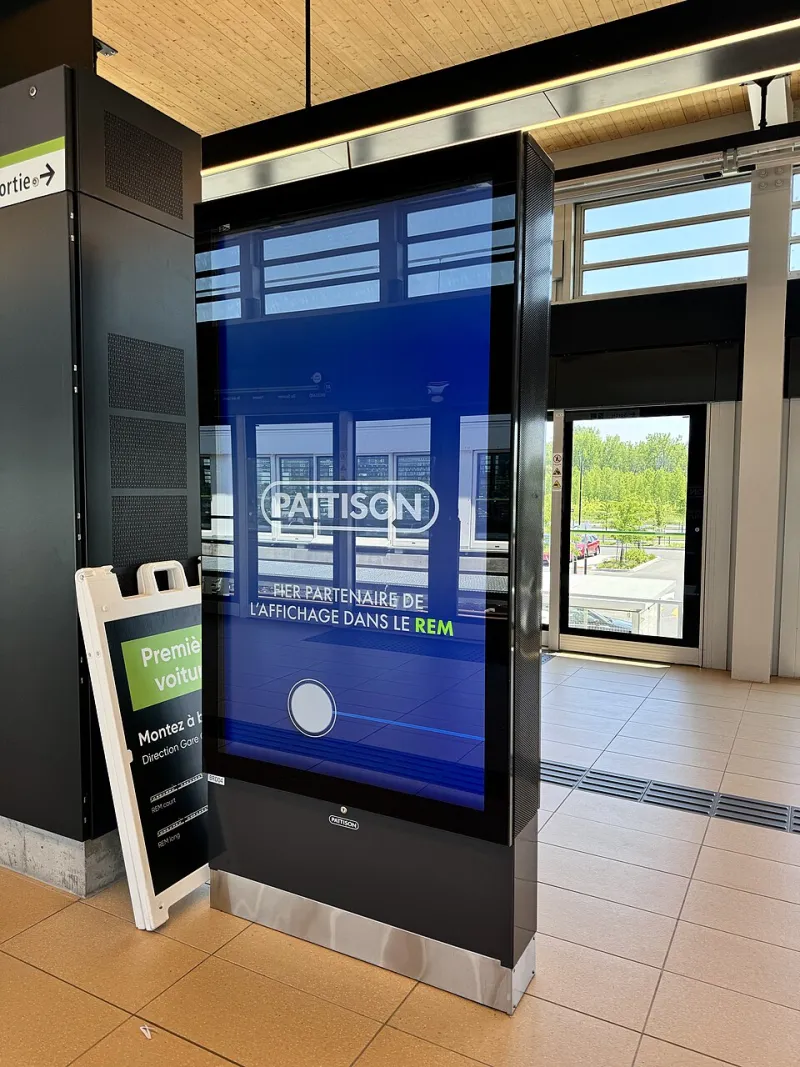
Photo: Harrison Keely, CC BY 4.0, via Wikimedia Commons
Outdoor digital signage is frequently sold on a single number: nits. For UK trade buyers specifying forecourt totems, high street screens or transport hub displays, that figure is a weak proxy for performance. In 2026, datasheets are more detailed than ever, but the distance between laboratory brightness and site legibility remains considerable. A display that looks impressive in a showroom can fail in low winter sun, behind reflective glass, or inside a sealed enclosure on a south-facing wall.
Why a nits rating is not a readability guarantee
Nits, or candelas per square metre (cd/m²), describe luminous intensity per unit area. Manufacturers typically quote a peak figure, often measured with a full-white test pattern for a limited period. That is not the same as sustained brightness in a warm enclosure running commercial content for sixteen hours a day. Nor does it account for the reflections, contrast and viewing angles that determine whether a passing motorist or pedestrian can read the screen.
Legibility is a function of contrast, not brightness alone. A 2,500 cd/m² display behind highly reflective glass can be less readable in low sun than a 1,500 cd/m² unit with effective anti-reflective treatment and a well-matched content strategy. Ambient light matters, but so does the direction of that light. UK forecourts combine bright canopy lighting at night with wet tarmac reflections and low-angle sun during the day. High streets introduce shadow patterns from buildings and awnings. Transport hubs add sheltered concourses where the screen may face outward into daylight while the viewer stands in shade.
Buyers should ask for sustained brightness after thermal stabilisation, contrast measured under realistic ambient light, and reflectance figures for the specified glass. A single peak nits number should be treated as a starting point, not a specification.
The UK light problem: low sun, wet surfaces and long shadows
The UK’s latitude produces low sun angles for much of the year. In autumn and winter, sunlight can strike a display almost horizontally, creating glare that no reasonable brightness increase will overcome. Wet surfaces amplify the problem by adding reflected light from below. A forecourt totem facing east or west may be readable at midday and unusable at 08:00 or 16:00 depending on the season.
Specifiers should consider orientation, hoods, louvres and glass treatments as part of the display system, not as accessories. Anti-reflective glass and matte surface finishes can improve perceived contrast more cost-effectively than adding nits. Content design also matters: high-contrast typography, restrained colour palettes and sufficient dwell time support readability better than saturated imagery that looks impressive in a proposal but collapses in daylight.
At transport hubs, displays are often mounted under canopies where the viewer’s eye is adapted to lower light levels. In these positions, excessive brightness can cause discomfort and wash out detail. Ambient-light sensors and scheduled brightness profiles are useful, but they must be configurable and documented at handover.
Heat is the hidden specification
Brightness creates heat. A display driven at maximum output inside a sealed enclosure will derate, whether or not the datasheet acknowledges it. UK summers are not tropical, but the 2022 record of 40.3°C in England demonstrated that outdoor enclosures can exceed their design limits. Forecourt totems add diesel particulates to the cooling problem; coastal sites add salt; high street cabinets collect litter and dust.
Passive cooling is simpler but depends on surface area and airflow. Active cooling with fans and filters improves thermal headroom but introduces service items. Heat exchangers and air-conditioning units add cost and maintenance. Buyers should request a thermal derating curve showing sustained brightness at a stated ambient temperature, typically 40°C, and ask how that figure changes when the display is mounted in the proposed enclosure. Fan mean time between failures, filter service intervals and replacement part availability are legitimate procurement questions.
A display that cannot sustain its rated brightness in July is not a resilient specification. It is a maintenance liability with a warranty attached.
IP ratings and the service access question
Ingress protection ratings are necessary but frequently misunderstood. An IP65 front face is common on outdoor displays; the rear of the same unit may be IP54 or lower. That matters when the enclosure is pressure-washed or when driving rain combines with wind. IP ratings also say nothing about condensation. Sealed displays can suffer internal misting unless heaters, breathers or desiccant systems are specified and maintained.
Service access is often the largest hidden cost. A rear-service display mounted against a wall may require scaffolding or a pavement licence to maintain. Front-service designs allow maintenance from the street side, but they introduce different sealing and lock requirements. Transport hubs and high street locations need rapid swap-out procedures, lifting points and spare parts held in the UK. Warranty terms should be read for labour, access equipment and response times, not just parts.
For forecourts, the practical question is whether a technician can safely access the display without closing the site. For high streets, it is whether the unit can be maintained without disrupting pedestrians or requiring highway permits. These are design decisions, not afterthoughts.
Procurement questions that separate signal from noise
Trade buyers can cut through headline claims by asking a consistent set of questions:
- What is the sustained brightness after sixty minutes at 40°C ambient, not the peak figure?
- What is the measured contrast ratio under 10,000 lux with the specified glass and content?
- What is the power consumption at full output and at a typical content profile?
- What cooling method is used, and what is the filter service interval and fan mean time between failures?
- What are the front and rear IP ratings, and how is condensation controlled?
- Is service front or rear access, and what clearance and lifting equipment are required?
- What brightness depreciation is warranted over five years, and what constitutes a valid claim?
- Are spare parts, CMS licences and firmware support available in the UK for the expected service life?
Total cost and the overpaying trap
There is a real risk of buying brightness that cannot be used. A 5,000 cd/m² display running at maximum output in a hot enclosure may consume more power, derate sooner and fail earlier than a 2,000 cd/m² unit with better contrast and thermal design. Conversely, under-specifying brightness and running a display at its limit reduces service life and increases maintenance visits.
The sensible approach is to specify the outcome: a readable image under stated ambient conditions, at the intended viewing distance, for the expected duty cycle. A site trial with a lux meter, the proposed content and a brightness meter is more valuable than another datasheet comparison. Include measured performance, thermal settings, service access arrangements and spare parts availability in the handover pack.
Outdoor displays are long-term infrastructure. The nits figure is easy to market and easy to compare, but it is not a complete specification. UK buyers who look beyond it, and who treat heat, reflectance and service access as first-order requirements, will pay for legibility rather than for a badge.