Bonded, Not Bolted: A Surge-Protection Framework for UK Camera Estates
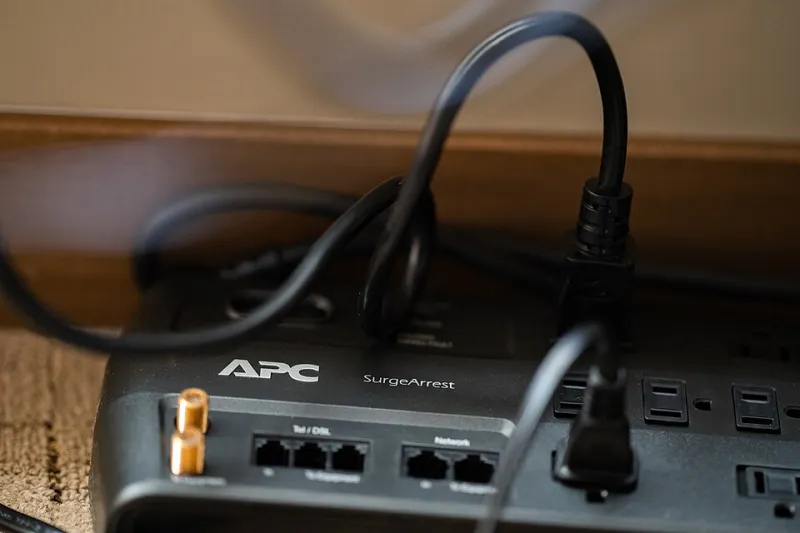
Photo: Tony Webster from Minneapolis, Minnesota, United States, CC BY 2.0, via Wikimedia Commons
A camera estate that fails after a thunderstorm is often described as unlucky. In practice, the pattern is more mundane. A PoE injector has been replaced twice, a pole-mounted camera reboots intermittently, and a switch port has failed without explanation. The lightning strike may have been several hundred metres away. The missing element is frequently not a surge protection device (SPD) in isolation, but a coordinated protection chain that includes the device, the earthing system and the bonding of every metallic path into the equipment enclosure.
For UK trade buyers, this matters because surge protection is still too often treated as an accessory rather than infrastructure. It appears in the warranty small print, or as a line item added after the camera schedule has been fixed. A more defensible approach is to treat surge protection as a design discipline: assessed against UK lightning risk, specified by type and voltage protection level, bonded to a common earthing arrangement, and proved at commissioning.
A risk profile that is British, not tropical
The UK does not experience the strike frequencies of equatorial regions, but frequency is the wrong measure. A single indirect strike can induce damaging surges on long outdoor cabling, particularly where cameras are mounted on exposed poles, parapets or perimeter fences. The risk assessment in BS EN 62305 is the recognised starting point, but it should not be reduced to a box-ticking exercise. It should ask practical questions: how long is the outdoor cable run, how exposed is the structure, what services enter the building, and what is the consequence of a camera or switch failure at that location?
A retail park, a coastal depot and a rural distribution centre will produce different answers. So will a site with a large metal canopy or a roof-mounted ANPR gantry. The assessment should inform the SPD specification, not follow it.
Three types, one chain
SPDs are commonly described as Type 1, Type 2 and Type 3. The distinction is not a hierarchy of quality; it is a statement of where the device sits and what surge current it is expected to handle. Type 1 devices are installed at the origin of the installation, where a direct strike or a large partial lightning current may need to be discharged. Type 2 devices are used on distribution boards to limit residual surges. Type 3 devices provide local protection close to sensitive equipment.
The practical failure mode on UK camera estates is a Type 3 device fitted at the camera without adequate upstream coordination. A small local SPD cannot compensate for a missing Type 1 or Type 2 device at the origin, and it may not survive the energy let through by an uncoordinated system. The specification should therefore describe a coordinated chain from the main intake to the camera enclosure, with compatible devices from the same manufacturer or a documented coordination table.
Voltage protection level is the number that matters to the camera, switch and recorder. The residual voltage at the equipment terminals must sit below the withstand level of the equipment, with margin. For PoE equipment, the SPD must also be compatible with the PoE voltage and current, and must not introduce unacceptable insertion loss or data errors.
The earth is the specification
An SPD without a low-impedance path to earth is decoration. Earthing and bonding are therefore part of the surveillance specification, not an electrical contractor's afterthought. Camera poles, metal enclosures, cabinets, cable trays and switch racks should be bonded to the protective earthing system in accordance with BS 7671. Where a separate lightning protection system exists, the bonding arrangement must be coordinated with it under BS EN 62305.
The earthing arrangement also matters. A TN-S, TN-C-S or TT system will behave differently under surge conditions, and the SPD selection must match the installation. On TT systems, the performance of the earth electrode and the residual current device coordination deserve particular attention. The buyer should ask for earth continuity and resistance test results, not simply a declaration that the system is earthed.
A common error is to create a separate earth for the CCTV system, particularly at a remote pole or cabinet. That can introduce a potential difference between the camera earth and the head-end earth, which is exactly the condition a surge wants. The objective is equipotential bonding: all metallic services entering the equipment should be bonded together and to the main earthing terminal.
At the camera, switch and head-end
At the camera, an outdoor-rated Ethernet surge protector should be fitted close to the equipment and bonded to the local enclosure. The device should be specified for the data rate, the PoE standard and the environmental conditions. The enclosure itself should be suitable for the site, with cable entries that do not compromise the seal.
At the switch, data-line SPDs protect the ports that feed outdoor runs. This is often the most cost-effective intervention because a single switch can serve multiple cameras, but it does not remove the need for local protection at exposed camera positions. At the head-end, Type 2 or Type 3 devices on the power distribution, together with signal protection on recorders and control equipment, complete the chain. Where fibre is used, the metallic path is broken, which reduces risk, but the power feed and the local enclosure still require protection.
Proving it: schedule, test, record
Surge protection should be commissioned like any other safety system. That means an SPD schedule identifying device type, location, protected circuit and voltage protection level; a visual inspection of status indicators; earth continuity tests; and a record of the results in the handover pack. Replaceable cartridges should be labelled, and the maintenance regime should include periodic inspection, particularly after storms or electrical works.
In 2026, a UK buyer should expect the warranty position to be explicit. If the manufacturer requires SPDs for warranty validity, that requirement belongs on the bill of materials, not in a footnote. The cheapest way to protect a camera estate is to design the protection chain before the first pole is drilled, bond it properly, and prove it at handover. Anything less leaves the estate waiting for the next storm to reveal the gap.