Seconds Before the Generator: A Load-First Method for Power Continuity on UK Camera Estates
Ask three people at a UK camera estate how long the site should keep running without mains and you will usually get three numbers and no reasoning behind any of them. The installer quotes the runtime on the battery cabinet label. The facilities manager quotes whatever the last resilience review said. The security manager quotes the length of the longest outage they can remember, which is not a specification at all.
Ride-through is not a product attribute. It is a design decision about which functions must survive an interruption, for how long, and in what state they must be when the power returns. Get that decision written down first and the hardware choice becomes almost arithmetic.
Define the safe state before anyone quotes a box
A camera estate does not have a single safe state. It has a hierarchy. In most UK deployments the top tier is narrow: recording on the cameras covering designated zones and cash-handling areas, the network core that carries those streams, the recorder holding the evidence, the door controllers with their audit logs, and the intercom serving any manned entrance. Everything else — the car park overview, the loading bay PTZ, the ANPR lane with no traffic at three in the morning — can drop without consequence.
Build that hierarchy as a table with five columns: asset, function, tolerable interruption, restart time, priority. That table is the specification. A UPS sized without it is a guess with a warranty attached, and a guess that will be tested by the first named storm of the winter.
Nameplate ratings are not demand
Manufacturers publish maximums because maximums are defensible. A 48-port switch with a 740 W PoE budget will not draw 740 W; it will draw whatever the connected devices ask for, plus the switch's own overhead. Add up the actual consumption figures for each camera, including heaters and IR illuminators on cold nights, then apply a modest headroom of fifteen to twenty per cent for growth and tolerance.
Where possible, measure rather than calculate. A clamp meter on the distribution board logging over a full week will reveal the peaks nobody predicted: the video wall switching on at shift change, the PTZ wash cycle, the door strike on a busy Monday morning. Two numbers matter and they are not the same number. Peak apparent power determines the UPS rating. Energy over time, in watt-hours, determines the battery string.
Power factor deserves attention too. Cameras with active power factor correction sit comfortably above 0.9; cheaper plug-top supplies can fall to 0.6, which means a cabinet full of them demands far more apparent power than the wattage on the data sheet suggests.
The battery is the weakest and hottest component
Valve-regulated lead-acid batteries are quoted with a design life at 25 °C, and that figure is deeply sensitive to temperature. Every ten degrees above 25 °C roughly halves expected service life. A cabinet installed in a plant room running at 32 °C turns a nominal five-year battery into a two-and-a-half-year consumable, and nobody notices until the first real outage.
Runtime is affected in the same direction. End-of-life capacity is typically half to two-thirds of the figure quoted when new, so a system sized to give sixty minutes on day one may give thirty in year four. Either size for the degraded case or accept a shorter replacement cycle — but decide which, and put the decision in the maintenance schedule.
Annual impedance or conductance testing gives a far better picture than a voltage check, which tells you almost nothing about remaining capacity. Battery monitoring is inexpensive relative to a failed evidence chain.
The transfer window is where most designs fail
A standby generator does not start instantly. Fifteen seconds is a reasonable expectation in good conditions; a cold morning, a sluggish fuel line or a long cable run can push that to thirty seconds or more before the supply is stable enough to transfer. Whatever bridges that gap must have margin, not a calculation that happens to balance.
A second consideration is repeated interruption. Storm restoration is rarely a single event. Supply can return and fail again four or five times in an hour as the distribution network operator recloses sections of the network, which means repeated generator cranking and repeated transfer transients. The bridging UPS absorbs each one, and the changeover logic should be configured to avoid unnecessary start cycles.
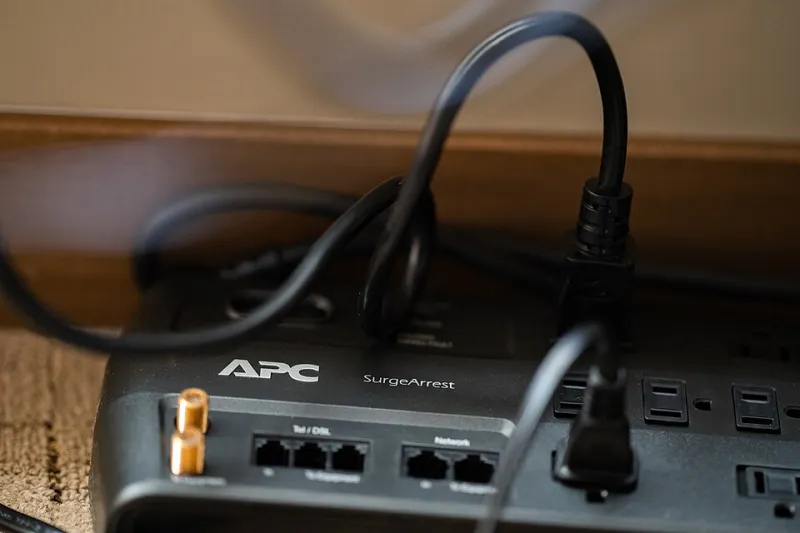
For the network core and the recording server, an online double-conversion unit is the safer choice: it delivers a clean waveform through the transfer rather than switching to it. Line-interactive units with transfer times of a few milliseconds are adequate for switch-mode power supplies on cameras, but they are not the right answer for equipment holding an evidence chain.
Sequencing the return
Restoration is often more demanding than the outage. Twelve cameras, a video wall and a rack of switches drawing inrush current simultaneously will trip a circuit that looked generously rated on paper. Staggered restart, either through the UPS configuration or through managed PDUs, turns a single large surge into a series of small ones.
Recorders need particular care. If ride-through is exhausted, the recorder should shut down cleanly rather than lose power mid-write. A short, deliberate shutdown window on the UPS protects the storage array and the time synchronisation state that the rest of the evidence chain depends on.
Doors, locks and the question nobody asks
Access control is where power design meets regulation. Electromagnetic locks fail unlocked without power unless they are battery-backed — fine for egress, poor for security. Door controllers hold the audit log, and that log is often the most valuable asset on the site after an incident. Egress arrangements must remain compliant in every power state, so the design question is not whether a door can be opened but whether it can be opened lawfully and recorded when it is.
Commission the proof, not the paperwork
A commissioning test should apply the real load — the actual connected equipment, not a resistive load bank — and measure how long the system holds before the first priority tier drops. Record the result with the date, the ambient temperature and the battery age. Repeat it annually, and note the degradation trend.
For generator-backed sites, monthly no-load exercise plus an annual on-load test is a reasonable baseline, along with fuel quality checks, changeover contactor inspection and clear labelling at every isolation point. For battery-only sites, a written replacement schedule tied to measured capacity beats a calendar date every time.
Ride-through is measured in seconds and in states. Decide the states, measure the load, size for the battery you will have in year four rather than the one delivered on day one, and prove it before winter does it for you.