Lens Before Megapixels: Specifying ANPR and Forecourt Cameras for UK Sites
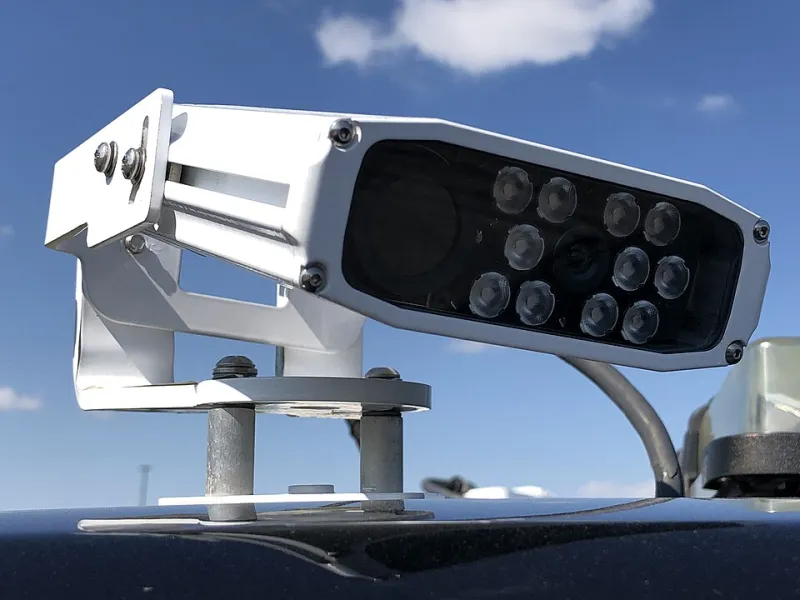
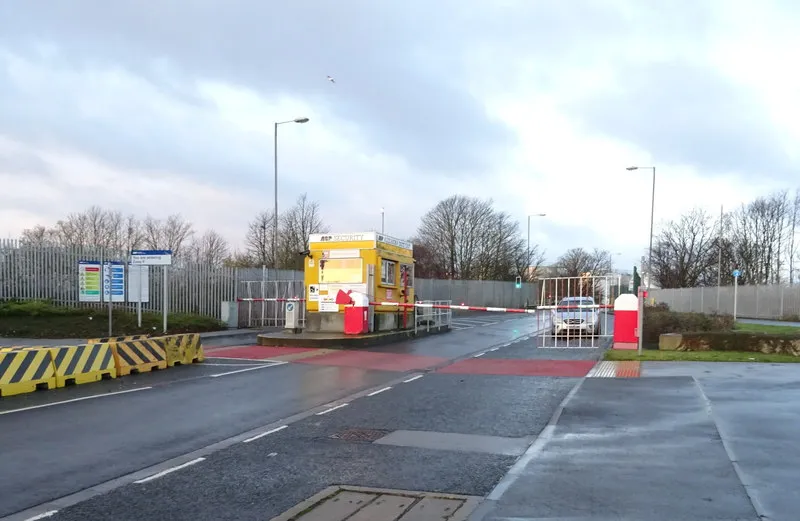
Photo: Mbrickn, CC BY 4.0, via Wikimedia Commons
Megapixel counts are easy to market and easy to misread. On a UK forecourt, car park or industrial gate, the identification task is rarely a question of how many pixels the sensor contains. It is a question of how many pixels land on the number plate, how consistently they land there after dark, and whether the shutter is fast enough to freeze a moving vehicle. A high-resolution camera with an unsuitable lens can produce a sharp-looking overview and a useless plate image. A lower-resolution camera with the right focal length, aperture and illuminator can deliver the evidence.
Start with the task, not the sensor
ANPR, overview and evidence-grade capture are different duties. ANPR needs a plate of sufficient pixel width at a defined capture zone, with controlled angle and exposure. Overview needs situational awareness across a wide area. Evidence-grade capture needs enough detail for a human reviewer to identify a person, vehicle or incident after the event. One camera rarely does all three well. Specifying a single 4K model to cover every duty often sacrifices pixel density where it matters.
Focal length and field of view
Focal length determines magnification. Sensor size determines the field of view that the lens can deliver. A longer focal length narrows the field and increases the number of pixels on a target at a given distance. That is why a 1080p camera with a well-chosen long lens can outperform a 4K camera with a wide lens for plate capture. Buyers should ask for the plate width in pixels at the intended capture distance, not just the sensor resolution.
Aperture, low light and motion blur
Aperture is expressed as an f-number. A lower f-number lets in more light, which helps in low light, but it also reduces depth of field. On a forecourt, the capture zone may be several metres deep, so the lens must hold focus across the plate position. Shutter speed is equally important. A slow shutter may brighten the image but smear a moving vehicle. ANPR needs a fast shutter and adequate illumination, whether from ambient light, IR or white light.
IR correction and reflective plates
UK number plates are retro-reflective. That helps ANPR at night, but it also creates exposure challenges. A camera without a true day/night mechanism and removable IR-cut filter may produce soft or colour-shifted images under IR. An illuminator that is mismatched to the lens angle can overexpose the plate centre and leave the edges dark. Check the IR range, beam angle and camera sensitivity as a system, not as separate datasheet figures.
Depth of field and mounting geometry
Mounting height and angle affect recognition. A camera mounted too high or too far to the side may see the plate at an angle that reduces character separation. The lens must be focused at the plate capture zone, not at the horizon. Depth of field should cover the expected vehicle positions. For dual-lane ANPR, separate cameras and lenses are usually more predictable than one wide camera trying to cover both lanes.
Matching lens and sensor for three common duties
For ANPR, prioritise a narrow field, long focal length, fast shutter and controlled illumination. For overview, prioritise wide coverage, good low-light performance and balanced WDR. For evidence-grade capture, prioritise pixel density on the subject, stable focus and recording quality. Compression, frame rate and bitrate also affect evidence; a high-resolution sensor with aggressive compression can lose the detail that the lens delivered.
Specification checklist for buyers
- Define the task and the target: plate, person, vehicle or incident.
- State the capture distance and the required plate width in pixels.
- Match focal length to sensor size and mounting position.
- Check aperture, shutter speed and low-light sensitivity as a system.
- Confirm true day/night operation and IR-cut filter behaviour.
- Verify IR illuminator angle, range and overexposure control.
- Test depth of field across the actual capture zone.
- Review sample images day and night, dry and wet, stationary and moving.
- Check WDR, compression, frame rate and bitrate for evidence use.
- Confirm PoE, IP rating, housing and bracket suitability.
- Validate privacy masking, data retention and signage for UK GDPR.
- Avoid accepting megapixels alone as proof of identification performance.
Resolution is useful, but it is not a specification on its own. For UK ANPR and forecourt CCTV, the lens, sensor, illumination and geometry must be matched to the identification task. Buyers who test the whole optical chain will get more reliable evidence than buyers who simply buy the biggest number on the box.